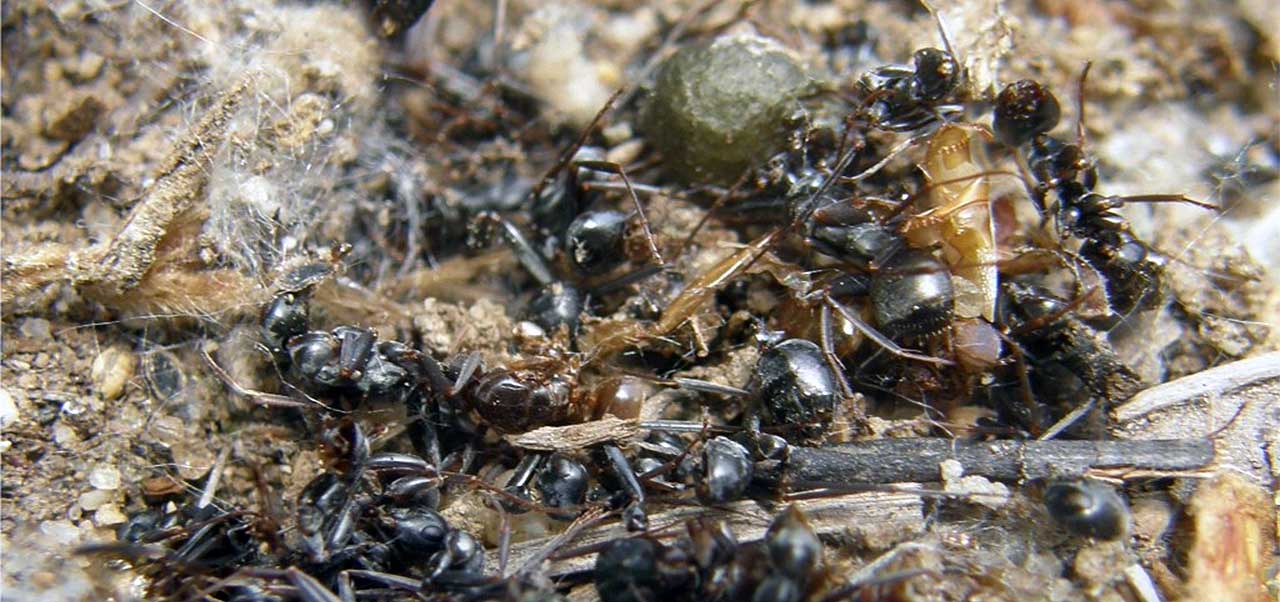
Ants have graveyards.
Ants Actually Do Have Graveyards (But Not For The Reason You Think)
If you've ever watched ants closely, you might've noticed something oddly... funeral-like. Worker ants will pick up their dead companions and carry them away from the colony. But where are they taking them? Turns out, ants really do have graveyards—though the reason has nothing to do with grief and everything to do with good housekeeping.
These designated dumping grounds are called midden piles, and they serve as combination graveyards and garbage dumps. Dead ants, food scraps, shed exoskeletons—it all goes to the same spot, usually located a safe distance from the nest entrance. Some species even maintain underground cemetery chambers within their elaborate tunnel systems.
The Chemical Death Signal
Here's where it gets fascinating: ants don't recognize death the way we do. They can't tell a dead ant from a living one just by looking. Instead, they rely on smell.
When an ant dies, decomposition begins within about two days. As fats break down in the corpse, they release specific chemicals—primarily oleic acid and linoleic acid. These compounds act as a death signal, triggering an automatic response in living ants: pick up this body and remove it immediately.
Scientists have actually tested this. When they dabbed oleic acid on living ants, the poor things got carried to the graveyard despite being very much alive and probably quite confused about it. Once the chemical wore off, they simply walked back to the colony like nothing happened.
Why Bother With Burials?
This isn't about respect for the dead—it's pure survival strategy. Dead ants can harbor bacteria, fungi, and parasites that threaten the entire colony. By removing corpses quickly and storing them far from living quarters, ants prevent disease outbreaks in their densely-packed underground cities.
The behavior is called necrophoresis, and it's surprisingly sophisticated. Recent research using experiments and computer modeling has shown that ant cemeteries form through simple clustering rules: drop the body near other bodies. Over time, this creates organized piles without any central planning or undertaker-in-chief giving orders.
The Graveyard Grows
What's particularly interesting is how these graveyards develop. Worker ants follow basic programming: if you're carrying a corpse and you detect oleic acid nearby, drop your burden there. No complex maps, no memory of where the cemetery is located—just chemical breadcrumbs leading to an ever-growing pile of the dead.
Different ant species handle this differently. Some maintain multiple midden piles around their territory. Others dig dedicated chambers deep underground, creating subterranean crypts that can contain hundreds or thousands of bodies. Fire ants are especially fastidious, maintaining their graveyards with almost obsessive regularity.
So yes, ants have graveyards. But while human cemeteries reflect our relationship with death, memory, and meaning, ant graveyards are monuments to something equally remarkable: the power of simple rules to create complex, life-saving behaviors. Even without understanding death, ants have evolved to manage it with impressive efficiency.