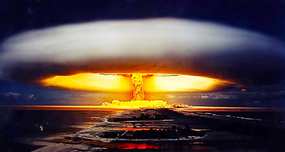
In 1958, a nuclear bomb was lost somewhere along the swampy coast of Georgia. Its whereabouts remain a mystery to this day.
The Nuclear Bomb That's Been Lost Off Georgia Since 1958
Somewhere beneath the murky waters off Georgia's coast lies a 7,600-pound nuclear bomb—and it's been there since 1958. This isn't the plot of a thriller novel. It's a real Cold War mishap that the U.S. military has never quite resolved.
On the night of February 5, 1958, a B-47 Stratojet bomber was flying a practice mission off the Georgia coast when an F-86 Sabre fighter jet accidentally collided with it during a simulated combat exercise. The collision severely damaged the bomber, and the crew faced a terrifying decision: try to land with a nuclear weapon on board, or jettison it into the ocean.
They chose the latter. The pilot dropped the Mark 15 hydrogen bomb into the waters near Tybee Island, expecting to retrieve it later. The crew survived, landing safely at Hunter Army Airfield. But the bomb? It vanished into Wassaw Sound.
The Search That Found Nothing
The very next day, the Air Force launched an intensive search operation. For months, Navy personnel scoured the seafloor with sonar equipment and underwater detection gear. By April 16, 1958, they gave up. The official word: the bomb was irretrievably lost.
In 2001, the military commissioned another hydrographic survey. Their conclusion? The weapon likely lies buried under 5 to 15 feet of silt and sand. Translation: it's not going anywhere, and they're not digging it up.
But How Dangerous Is It?
Here's where things get murky—and controversial. The big question: did this bomb have its plutonium core installed?
The Air Force insists it didn't. According to their records, the bomb carried a simulated 150-pound lead cap instead of the nuclear capsule needed to trigger a nuclear explosion. If that's true, the weapon couldn't produce a nuclear blast, though it could still cause a conventional explosion from its TNT components.
But in 1966 Congressional testimony—declassified in 1994—Assistant Secretary of Defense W.J. Howard said something different. He testified that the Mark 15 was "a complete, fully functional bomb with a nuclear capsule," meaning it did contain weapons-grade plutonium.
So which is it? Nobody seems entirely sure, and the military's story has shifted over the decades.
What If It Exploded?
Even without certainty about the plutonium core, we know this much: the Mark 15 was designed with a maximum yield of 3.8 megatons—roughly 190 times more powerful than the bomb that destroyed Nagasaki. If it were fully armed and somehow detonated, it could devastate the Savannah area.
The good news? Nuclear weapons don't just go off on their own. They require a precise sequence of triggers. Sitting at the bottom of the ocean, corroding under silt, this bomb is almost certainly inert. The greater risk would be environmental contamination if the casing eventually ruptures and releases radioactive material.
Why Haven't They Recovered It?
Cost, complexity, and risk. The bomb is likely buried under thick sediment in shifting underwater terrain. Any recovery operation would be monumentally expensive and could potentially be more dangerous than leaving it alone. The Department of Defense's position has essentially been: if it's not causing problems now, don't poke it.
Local residents have mixed feelings. Some want answers. Others have made peace with living near an underwater nuclear time capsule. A few have even turned it into dark tourist lore—Tybee Island's most explosive secret.
The Tybee bomb isn't alone. The U.S. military has lost multiple nuclear weapons over the decades in incidents known as "Broken Arrows." But this one remains perhaps the most infamous—a 12-foot-long reminder that even superpowers sometimes lose track of their most dangerous toys.
Frequently Asked Questions
Where exactly is the lost nuclear bomb off Georgia?
How did the US lose a nuclear bomb in 1958?
Is the Tybee Island bomb dangerous?
Has the US ever found the lost Tybee bomb?
How powerful was the 1958 lost nuclear bomb?
Related Topics
More from History & Culture