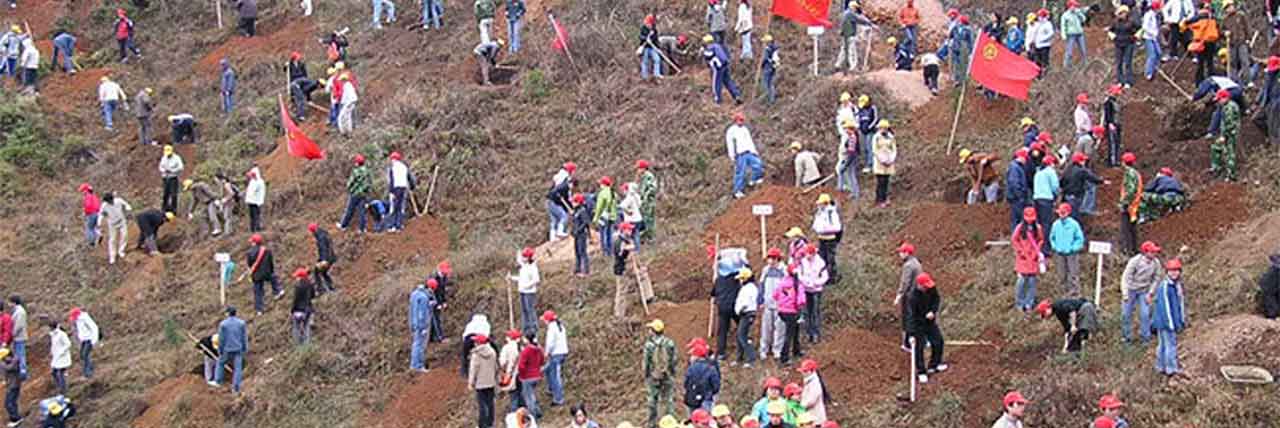
In 1981, the Chinese government passed a resolution making it a duty for every citizen aged 11 and older to plant at least three trees per year, creating the world's largest reforestation program.
China Requires Every Citizen to Plant Trees Annually
Imagine a law that turns an entire nation into a forest-building machine. That's exactly what China did in 1981 when the National People's Congress passed a resolution requiring every citizen aged 11 and older to plant at least three trees per year—or do the equivalent in other greening activities.
The Birth of a Green Revolution
On March 12, 1981, China launched what would become the world's largest reforestation program. The timing wasn't random—March 12 was designated as National Tree Planting Day, commemorating the death anniversary of Sun Yat-sen, who was a strong advocate for forestry.
The resolution didn't just suggest tree planting. It made it a civic duty, placing it alongside other obligations like paying taxes and serving in the military. Citizens who couldn't plant trees could fulfill their duty through other activities like seedling cultivation, forest management, or contributing to greening funds.
The Numbers Are Staggering
The program's scale is almost incomprehensible:
- Over 70 billion trees have been planted since 1981
- China's forest coverage has increased from 12% to over 23%
- Approximately 500 million citizens participate annually
- The country aims to reach 26% forest coverage by 2035
To put this in perspective, China now plants more trees each year than the rest of the world combined. The country has become the global leader in adding new forest area, accounting for about 25% of the world's net gain in leaf area since 2000.
More Than Just Planting
The program evolved significantly over the decades. In 2017, China introduced internet tree planting to engage younger generations. Citizens can now fulfill their duty through apps like Ant Forest, which lets users earn "green energy" points through low-carbon activities. These points translate into real trees planted in arid regions.
The initiative has become so ingrained in Chinese culture that many corporations, schools, and government offices organize annual planting events. Some provinces have turned it into community festivals, complete with ceremonies and celebrations.
The Environmental Impact
China's motivations weren't purely environmental—they were existential. Decades of deforestation had left the country vulnerable to devastating dust storms that would blanket cities in yellow haze and even reach as far as Korea and Japan.
The "Great Green Wall" project, part of this broader effort, aims to stop the expansion of the Gobi Desert by planting a 4,500-kilometer forest barrier. While questions remain about the ecological wisdom of some planting choices—monoculture forests aren't as resilient as natural ones—the sheer ambition is undeniable.
The program has also become a model for other nations grappling with deforestation and climate change. Ethiopia, India, and several African nations have launched similar mass-planting initiatives, though none match China's scale or duration.
A Law Unlike Any Other
What makes this resolution remarkable isn't just its scope—it's the idea that environmental stewardship could be mandated as a civic duty. Whether you're a factory worker in Shenzhen, a teacher in rural Sichuan, or a tech executive in Beijing, the expectation is the same: contribute to your nation's greenery.
Critics argue that mandatory planting can lead to poor tree selection and high mortality rates. But supporters counter that the program has fundamentally changed how Chinese citizens think about their relationship with nature. After four decades, tree planting isn't just a duty—for many, it's a tradition passed down through generations.